
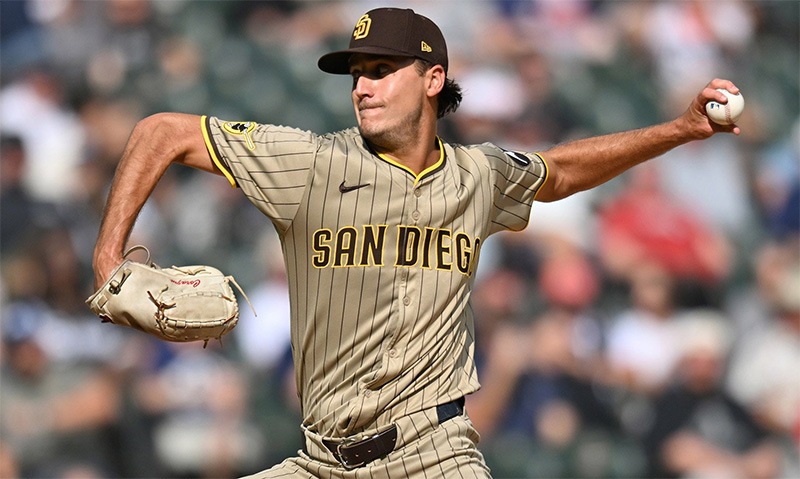
Kyle Hart’s performance this season shows his worth. So far in 2025, he’s got a strikeout rate of 21.0% and a walk rate of 5.4%, giving him a K-BB% of 15.6%.
That gap is a clear and reliable shorthand for how frequently Hart changes plate appearances into positive outcomes (strikeouts) rather than longer, riskier ones (walks). The same dataset also indicates that Hart’s ERA (5.27) is higher than his expected numbers (xERA 3.39), implying that the actual results have been worse than the underlying process.
What makes that season K-BB% stand out is what Hart has done since he’s been primarily used in short relief. In his last seven games, he threw 8 2/3 innings, struck out 14 batters, and only walked two, leading to a 14:2 K:BB ratio (7.0 K/BB) during that stretch, with a 0.69 WHIP.
Changing that brief run into rate stats gives us roughly 15.37 K/9 and 2.20 BB/9 for that period, which are top-tier numbers for relievers and highlight a major shift in how he’s been going after hitters.
Hart relies heavily on a mix of pitches, using a sweeper, sinker, and four-seamer; this season, the sweeper makes up about a third of what he throws. This focus on the sweeper is because it has produced noticeable run value and a high whiff rate. With its positive run value and above-average whiff rate, it serves as a genuine putaway pitch. In short relief outings, Hart employs a tighter, more focused set of pitches, beginning with the four-seamer and ending with the sweeper. This approach helps transform swinging strikes into strikeouts while limiting walks.
There are two clear changes that align with his improved K-BB stats. Firstly, Hart’s fastball and overall velocity increased when he began pitching in shorter stints; the team’s internal reviews and public profiles of his relief efforts indicate a rise in average fastball velocity and a notable improvement in movement on the sweeper.
Next up, the sweeper has proven to be productive, boasting a positive pitch run value and a high whiff rate that sheds light on where many of those strikeouts originate. Those two tweaks, more power on the fastball and a crisper breaking ball, are the standard way to transition from a mediocre starter to a reliable reliever.
A reliever with Hart’s short-term K:BB numbers accomplishes two things right off the bat: he minimizes variance by not giving up free passes, and he produces swing-and-miss results that help finish innings quicker. When it comes to postseason talk, that’s just the sort of bridge work that ensures the top arms are available for the most critical situations.
Hart’s season surface stats (especially ERA and certain hard-contact metrics) reveal weaknesses when hitters make solid contact. His barrel and hard-hit percentages are significant, and a couple of ill-timed home runs have boosted his ERA compared to his xERA.
Thanks to Hart’s command and his putaway pitch, he avoids trouble most of the time, but when it does happen, it can hit hard. To put it another way, his low walk rates and good swing-and-miss stats keep him consistent, but the hard contact he allows is the risky element that can turn a critical moment upside down in no time.
The metrics (xERA lower than ERA, positive sweeper run value, and whiff rate) indicate that the recent improvements aren’t just a matter of luck. However, the hard-contact metrics and home-run vulnerability are the main factors limiting the ability to project a high-leverage role.
The Padres are getting value from Hart by utilizing him in short, specialized appearances where his velocity and sweeper can be effectively used. In this capacity, he minimizes leverage volatility, allowing the best relievers to have cleaner innings later on.
Full article can be found at: https://padresmission.com/news-rumors/san-diego-padres/kyle-harts-kbb-ratio-hints-at-potential-to-effectively-bridge-to-late-inning-relievers-r2659/